Showing posts with label PROG. Show all posts

Wednesday, April 22, 2009

047 EMERSON,LAKE AND PALMER-TARKUS


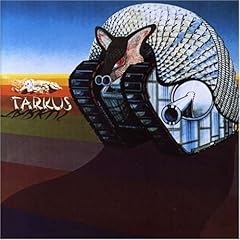
When it comes to Emerson Lake & Palmer, one of two pieces is usually voted the band's pinnacle of achievement: "Karn Evil 9" from 1973's BRAIN SALAD SURGERY or the titular suite from 1971's TARKUS. And if "Karn Evil 9" is one of my top candidates for Best Prog Work Ever, "Tarkus" is a monolithic achievement nevertheless, one of the first sidelong epics in the annals of progressive rock, and one of its greatest. Flying high on Keith Emerson's savage keyboards, grounded by Carl Palmer's seismic drumming, embroidered with Greg Lake's dour vocals and complementary bass licks, "Tarkus" alternates peaks of the loftiest beauty with storms of the basest profanity. There's a plot in Lake's overblown lyrics somewhere - I think it has to do with war, and the armadillo-tank on the LP cover, and something about a manticore as well - but lyrics have never been all that important in prog. They sound profound, and that's all that matters. The suite is partitioned into seven movements, but it's often difficult, amidst the hail of screaming organ solos and percussive whiplash, to discern where one ends and another begins. Besides, I listen to "Tarkus" as a whole, a mammoth example of everything good (and bad) about prog rock, so it's rather pointless to focus on the individual parts. It's a monster, to be sure, some of the most intricate, bloodthirstily confrontational music of the rock era. Two prog workouts ("Bitches Crystal", "A Time & a Place"), a pair of goofy throwaways ("Jeremy Bender", "Are You Ready Eddy?"), and a bipartite mini-epic ("The Only Way (Hymn)"/"Infinite Space(Conclusion)") flesh out the remainder of the disc. After a behemothic opening like the title cut, the rest of TARKUS should be an anticlimax, and in many ways it is. But if it doesn't achieve the demented grandeur of Side I, Side II allows the band to calm down, stretch out, and defuse their self-conscious pomposity a bit. "The Only Way (Hymn)"/"Infinite Space (Conclusion)" in particular is great, featuring ecclesiastical organ, blazing bass figures, and a couple melodies "borrowed" from Bach. If 70s prog ever needed a "poster band", there would be few acts better qualified to fill that role than ELP. By the same token, TARKUS plays about as near a 70s prog "poster album" as any album possibly could. -AMAZON.COM

Thursday, March 5, 2009

034 ANDERSON BRUFORD WAKEMAN HOWE-ANDERSON BRUFORD WAKEMAN HOWE


Anderson Bruford Wakeman Howe (sometimes referred to by the acronym ABWH) was a permutation of the progressive rock band Yes. The group consisted of vocalist Jon Anderson, drummer Bill Bruford, keyboardist Rick Wakeman, and guitarist Steve Howe (with Tony Levin on bass). These Yes alumni had played together in Yes on their most popular recordings in the early 1970s. Anderson Bruford Wakeman Howe recorded one self-titled studio album in 1989. A live recording from their subsequent concert tour was released years later in 1993, but their 1991 album material was co-opted by Arista Records for a Yes album.-WIKIPEDIA

Tuesday, March 3, 2009

023 GENESIS-SELLING ENGLAND BY THE POUND

The best rock jolts folk-art virtues--directness, utility, natural audience--into the present with shots of modern technology and modernist dissociation; the typical "progressive" project attempts to raise the music to classical grandeur or avant-garde status. Since "raise" is usually code for "delegitimize," I'm impressed that on half of this Peter Gabriel makes the idea work: his mock-mythologized gangland epic and menacing ocean pastorale have a complexity of tone that's pretty rare in any kind of art. Even more amazing, given past performances, organist Tony Banks defines music to match, schlocky and graceful and dignified all at once--when he's got it going, which is nowhere near often enough. As for the rest, it sounds as snooty as usual. B -
Robert Christgau

Monday, March 2, 2009

013 STEVE HOWE-THE STEVE HOWE ALBUM

DOWNLOAD
Steve Howe's second solo effort is his most essential recording. The Steve Howe Album contains many of Howe's strongest and most original compositions. Whereas some of his albums can be associated with the sound of the bands in which he's played, this release is unique. Howe places himself in a country/bluegrass setting on most of the compositions, and that is what makes this project so appealing — he's a rock veteran venturing outside of his field. And with Graham Preskett playing violin on "The Continental," Howe turns in what sounds like a real hoedown. The first track, "Pennants," is a gem for the more rock-oriented fan. The cut opens with the sweet, resonant, rocking sounds of Howe's Fender Telecaster; he then adds mandolin and a pervasive twin-neck steel, while drummer Alan White keeps it all rhythmic. Half of the tracks are played by Howe alone, most notably "Surface Tension," his composition for solo Spanish guitar. Other cuts feature former Yes-mates White, Bill Bruford, and Patrick Moraz (all of whom participated on Howe's first solo album), and Claire Hamill, who sings beautifully on "Look Over Your Shoulder." Only one other cut includes vocals: "All's a Chord," on which Howe's singing is awkward but appealing. The song, comprised of several movements and musical styles (including classical), features Howe on eight different stringed instruments, including bass, pedal steel, sitar, banjo, mandolin, and his trademark deep-bodied electric-acoustic Gibson ES 175 D. The final two pieces are set apart from the rest of the recordings. On both compositions, equipped only with his Gibson Les Paul, Howe is accompanied by a string ensemble on his interpretation of Vivaldi's Concerto in D, Second Movement, and by a 59-piece orchestra on "Double Rondo." Andrew Jackman (who served as orchestrator and conductor on Chris Squire's Fish Out of Water several years earlier) conducts. The Steve Howe Album is a culmination of everything Howe represents, every genre of music he loves so dearly, exquisitely played and arranged. The inside cover colorfully depicts all the stringed instruments Howe used on the recordings, and Roger Dean's cover painting makes the package complete. The sound quality of the Japanese import compact disc is unsurpassed, incredibly sharp and vibrant. -almusic.com

009 YES-FRAGILE

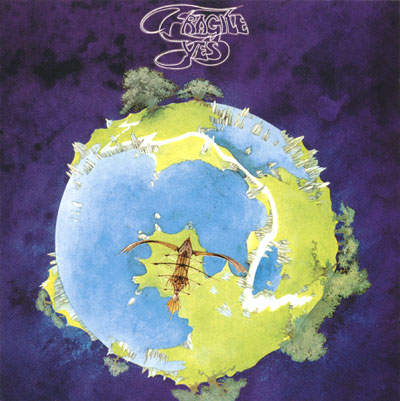
Fragile is the fourth album by the British progressive rock band Yes, released on Atlantic Records, catalogue 7211. It was the band's first album with keyboardist Rick Wakeman after the departure of Tony Kaye, and the first to feature cover art by Roger Dean, his work emblematic of both the band and progressive rock as a whole. Fragile was issued in the UK in November 1971, but was held back in North America for two months because of the chart momentum of The Yes Album. It peaked at #4 on the Billboard 200 during a stay of 46 weeks, and as Atlantic 2401 019 reached #7 in the UK album chart.

Work on the material began while Kaye was still in the band. In a 2006 interview, he said, "I did rehearse Fragile before I left. I left in the middle."[1] Four of the nine tracks feature full performances by the new line-up with Wakeman, three of which were of eight minutes length or longer. Its best known track, "Roundabout," was released in the United States in an edited version as a single. Rick Wakeman contributed to the writing of "South Side of the Sky" and "Heart of the Sunrise" by adding piano interludes to both songs, but wasn't credited due to contractual conflicts. He was instead promised more money by Atlantic studio executives, which he claims he never saw.

The remaining five tracks showcase the band members' individual talents. "Cans and Brahms" is an arrangement by Wakeman of the third movement from the Fourth Symphony in E minor by Johannes Brahms, his utilization of synthesizers adapted to classical works in vogue at the time, evidenced in efforts by Wendy Carlos and Isao Tomita. "We Have Heaven" is by Jon Anderson in which he sings all the vocal parts, a technique later used on his solo album Olias of Sunhillow. Bill Bruford's "Five Per Cent for Nothing" derives its instrumental passages from the rhythm line, while "The Fish" and "Mood for a Day" serve almost entirely as bass and guitar solo pieces for Chris Squire and Steve Howe, respectively.

Side one"Roundabout" (Anderson/Howe) – 8:30 "Cans and Brahms (Extracts from
Brahms' 4th Symphony in E Minor, Third Movement)" (Brahms, arranged Wakeman) –
1:38 "We Have Heaven" (Anderson) – 1:40 "South Side of the Sky"
(Anderson/Squire) – 8:02

Side two"Five Per Cent for Nothing" (Bruford) – 0:35 "Long Distance
Runaround" (Anderson) – 3:30 "The Fish (Schindleria Praematurus)" (Squire) –
2:39 "Mood for a Day" (Howe) – 3:00 "Heart of the Sunrise"
(Anderson/Squire/Bruford) – 11:27


DOWNLOAD

006 BRIAN ENO-ANOTHER GREEN WORLD

Another Green World is the third studio album by British musician Brian Eno. Produced by Eno, it was originally released by Island Records in September of 1975. As he had done with previous solo albums, Eno worked with several guest musicians including Phil Collins, John Cale and Robert Fripp. The album marked a great musical change from Eno's previous albums. Using his instruction cards the Oblique Strategies for guidance, the album contained less lyric-based rock songs and had stronger emphasis on instrumental productions; many without the aid of guest musicians. The dark humor of the lyrics also changed to more dreamlike and addled songs.
The album failed to chart in the United States or the United Kingdom. Initial critical reception met with both high praise from several critics, but also with negative reviews feeling the album was a to great of a departure from Eno's previous more rock music based material. Modern reception of Another Green World has been more unanimously positive with critics placing the album on several top albums lists as well as giving the album some of their highest ratings.


About Me

My photo
A Beatles fan since December 1980.Now an oral surgeon and music journalist.He lives in Bangkok.